

by Dr. Ben Schneider (University of Cambridge)
The fear that new technologies will cause mass unemployment appears during every wave of transformative innovation. Despite the recurrence of these discussions, including in ongoing debates about the effects of AI, many economists and economic historians, including the Nobel laureate Joel Mokyr, doubt that technology has ever caused large-scale job losses and long-term unemployment. They argue, for example, that similar narratives appeared in the 1960s without an obvious rise in the unemployment rate of rich countries. Moreover, while the Industrial Revolution is commonly mentioned as an instance of technological disruption, there is little quantitative evidence for unemployment caused by new technologies, referred to as “technological unemployment”.
These optimistic views are misleading. “In Technological Unemployment in the British Industrial Revolution: The Destruction of Hand-Spinning” my article in Past & Present no. 270, I systematically analyze job loss and subsequent unemployment in part of the British textile industry during the Industrial Revolution. In the space of a few decades beginning around 1770, new textile machines replaced work that had employed 8% of the British population. There was insufficient new work available in the growing factory districts to replace the lost jobs, and widespread unemployment and underemployment continued into at least the 1830s. This is the largest example of technological unemployment yet examined.
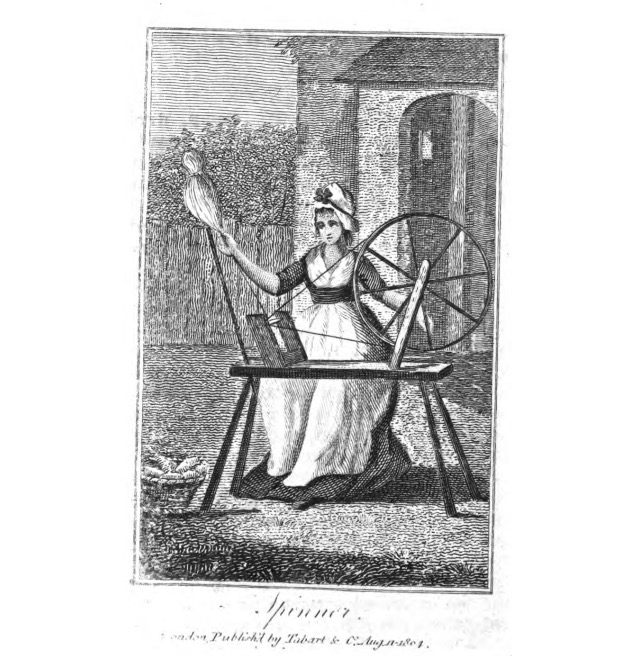
R. Phillips, The book of English trades, and library of the useful arts (London, 1818), 362. public domain, via Internet Archive, Wiki:Commons
Before the Industrial Revolution, spinning wool, cotton, or flax into yarn on a spinning wheel (hand spinning) was a major source of employment for women. Research by Craig Muldrew suggested that perhaps 10% of the population of England was employed in spinning by 1770; my more conservative estimate for Britain as a whole is 8%, or about 700,000 workers. Using either estimate, spinning was probably the largest employment outside of agriculture. It was also flexible work that women could fit around other labor, including seasonal farm work. Combining different types of work for multiple employers was common before the rise of regular full-time employment for one company. Spinning provided important income overall and could be the only option in parts of the year when there was no other work available.
New technologies transformed spinning and enabled much greater output per worker. The spinning machines, which were initially hand-driven, were soon powered by water wheels (from c. 1770) and later steam engines in factories, which greatly increased production and outcompeted the hand spinners. Hand spinners were first replaced in cotton spinning, which was the easiest to mechanize, and later in spinning wool and flax.
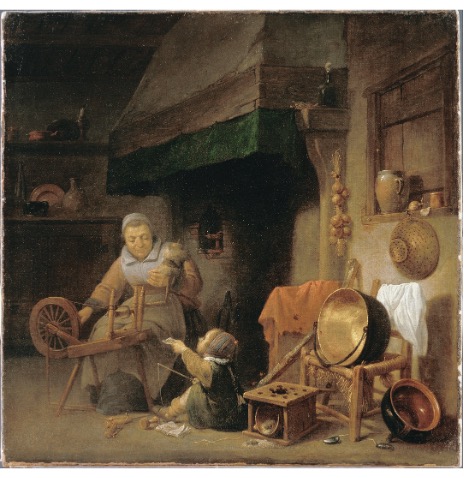
Pieter Nys, Woman Spinning, 1652, public domain, via Google Art Project and Wiki:Commons

Workers and their families were concerned that the new machines were taking their jobs, and they attacked and destroyed some spinning machines in the 1770s. Written complaints about the job-replacing effects of spinning machinery began to appear soon afterwards. One 1780 booklet proposed that the machines should be taxed because they were replacing workers, which may be the first example of an automation tax.
The main challenge of analyzing, and particularly quantifying, technological unemployment in this period is that there are no national unemployment statistics. Instead, I analyze more than 200 qualitative sources that provide evidence about the availability of work for women, which types of work were available, and discuss job losses caused by the new technologies. The most important sources are the surveys of social commentators around 1770 and in 1797, and responses by individual parishes to a survey by the 1834 Commission on the Poor Law.
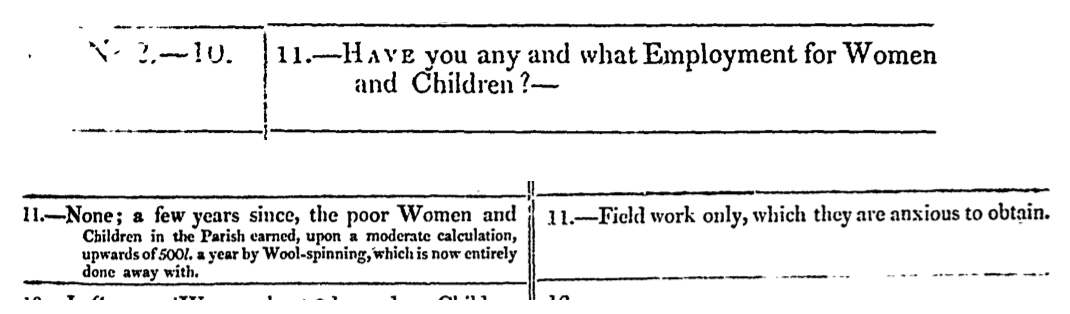
Report of the Poor Law Commissioners, page 461a (Laxfield and Livermere, Suffolk), image supplied by Dr. Ben Schneider
The first of these larger-scale sources is a set of books written by the agriculturalist and social commentator Arthur Young around 1770, describing observations of his three journeys around England and reports from his correspondents. At this point, employment was widely available for women, and spinning was reported in more than half of the locations for which Young provided information. In 1797, the social commentator Frederick Eden produced a three-volume analysis of the conditions of the poor, which also included information from specific locations about the availability of work, albeit for fewer places than Young had provided. At the end of the 18th century, Eden only found a handful of places with little work or seasonal work.
By the 1830s, factory spinning had entirely taken over, and the results were plain in the parish responses to the Poor Law Commissioners. Of the 1563 parishes that replied to the survey, 34% of them reported that there was little or irregular work for women, and a partly overlapping 19% stated that work was seasonal. In 14% of parishes there was no work for women. The loss of spinning employment was specifically mentioned, unprompted, by a number of parishes, and other qualitative sources that I examine in the article similarly pointed to the new technologies as the source of unemployment and deprivation.
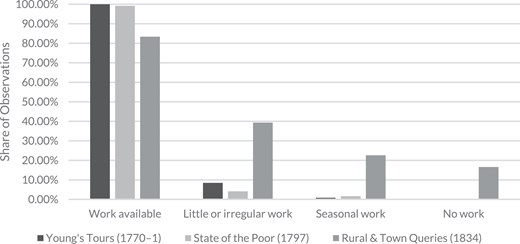
FIGURE 6 employment for women in england and wales, 1770–1834* * Note: This Figure excludes non-responses. * Sources: Derived from Tables 1, 3, 5 and A12 and the sources there. From Benjamin Schneider, “Technological Unemployment in the British Industrial Revolution: The Destruction of Hand-Spinning”, Past & Present no. 270 (2026) all rights reserved
I also match locations that were surveyed by Arthur Young and replied to the Poor Law Commissioners. This exercise allows us to see what happened in the same locations between c. 1770 and the 1830s. Work was available in all of these locations before the rise of factory spinning (there was little or irregular work in only one place), and spinning itself occurred in more than 40% of these places. By the 1830s, spinning was not reported in any of the same locations. As a result, half of them reported only little or irregular work for women, and more than 20% reported that work was seasonal. This pattern clearly matches the organization of women’s employment in this period. Few women had a single source of income, much less a formal occupation, so technological replacement of workers appears as a mixture of complete unemployment and widespread underemployment. Since women had particularly tended their spinning wheels when no agricultural work was available, when spinning disappeared, women would be left unemployed in seasons without farm labor. The parishes that replied to the Poor Law Commissioners document these developments.
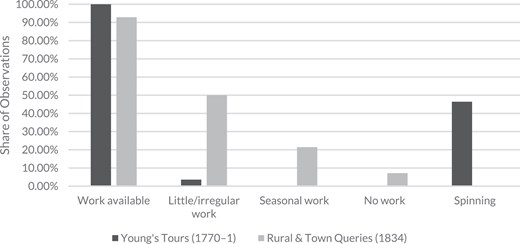
FIGURE 8 employment for women in matched parishes, 1770–1771 and 1834* * Sources: Young’s Tours (see n. 71); Royal Commission of Inquiry into Administration and Practical Operation of Poor Laws: Report, Index, Appendix, Parliamentary Papers, 1834 (44), xxxvii. From Benjamin Schneider, “Technological Unemployment in the British Industrial Revolution: The Destruction of Hand-Spinning”, Past & Present no. 270 (2026) all rights reserved
The absence of a labor force survey, which is used to construct current-day unemployment data, means it is not possible to say exactly how many women were replaced and left unemployed by industrial technologies. The historical sources only allow us to estimate the number of spinners before and after industrialization, and they report whether work was available in a specific place and the types of work available. However, the factory jobs created directly by new technologies employed a far smaller share of the British population (less than 1%) in the 1851 Census, and more than half of this group were men and boys. In 1770, 8% of the population (nearly all women and some children) had been employed in spinning. Therefore, about 7.5% of the population would have needed to find new types of work. While part of this group surely found work in sectors of the economy outside the new textile factories, reports of widespread unemployment and underemployment into at least the 1830s show that new technologies produced extensive employment loss.
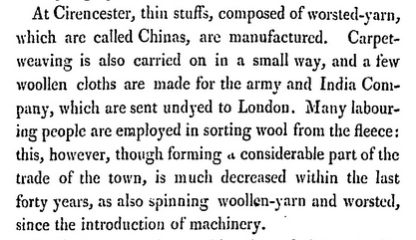
Rudge, “General view of the agriculture of the county of Gloucester” (1807), 341, image supplied by Dr. Ben Schneider
The replacement of such a large source of work for women and the lack of new opportunities may have contributed to women’s marginalization from paid work in the 19th century and the rise of the male breadwinner family. It was likely also an important reason that women’s paid employment in Britain did not return to pre-industrial levels until the 1980s.
This example is atypical in two important ways: spinning employed a large share of the British workforce in the late 1700s and the productivity advances were astonishing, increasing more than 100 times between 1760 and 1830. While most new technologies have not caused this scale of disruption, in ongoing work my colleague Jonathan Jayes and I have found other notable examples of job-replacing technology, some of which produced long-term unemployment.
The unemployment of hand spinners has been discussed by gender historians because most of the workers were women, although without systematic quantification. It has been ignored by most of economic history, and it does not appear in common economics and policy narratives about technology and work, even in those that mention history. Why has such a dramatic shift escaped attention? I suggest three main explanations. First, women’s employment in the past has been downplayed and underestimated, partly because it was organized differently from men’s work, featuring a wider array of different employments or jobs, meaning there is less surviving documentation. As a result, the loss of women’s employment could be seen as a minor episode. Second, some scholars have asserted that women voluntarily left paid work during the Industrial Revolution because they preferred housework or leisure. The scarcity of quantitative records is also part of the third explanation: there has not been a previous attempt to measure this job loss and unemployment, probably because economic historians have not considered the possibility of using qualitative sources in a systematic fashion. The lack of existing statistics meant that the unemployment of hand spinners was marginalized by quantitative economic history despite the mass of qualitative evidence.
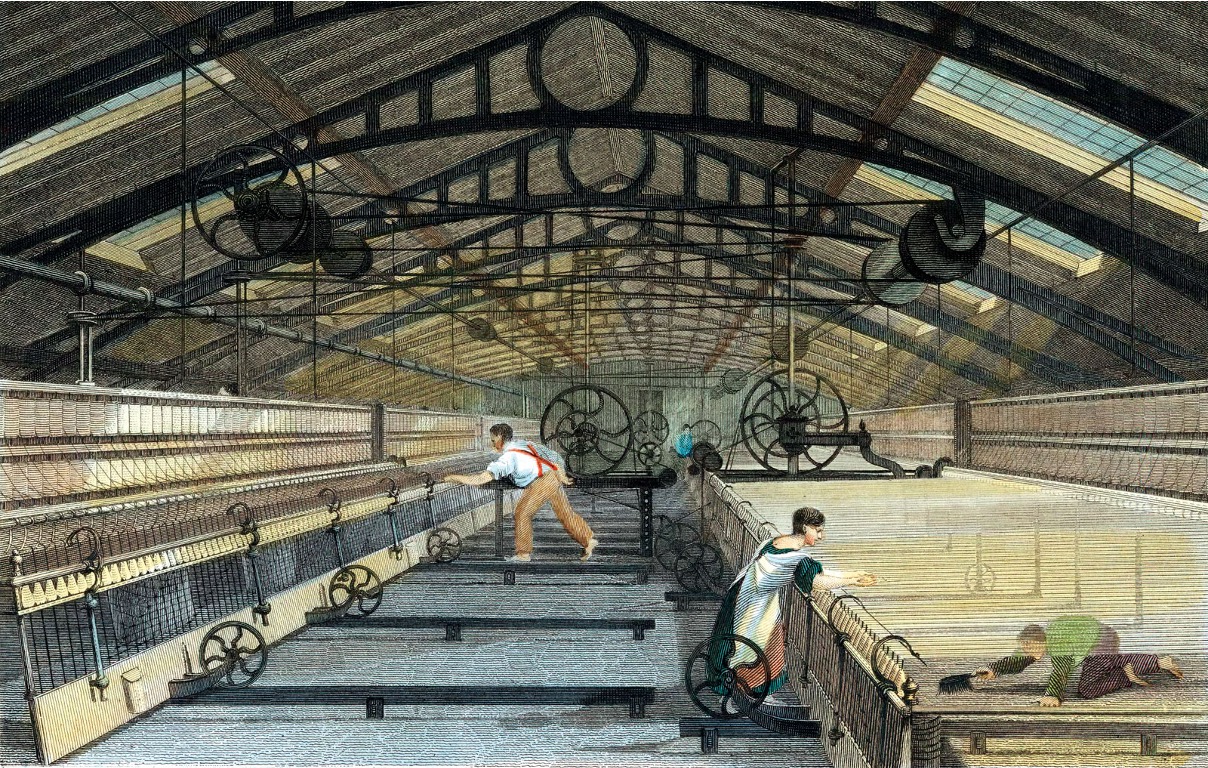
Colorized image of a mule spinning factory from Baines, History of the Cotton Manufacture of Great Britain (London, 1835), 211., public domain via Wellcome Collection
While many commentators discussing the possible changes to work caused by AI and automation suggest that technology has only caused minor, short-lived disruptions in the past, this episode demonstrates that mass job loss and long-run deprivation has followed dramatic technological change. The unemployment of hand spinners is a cautionary tale for the future of employment.