

our publications Journal, Books and Supplements
JOURNAL
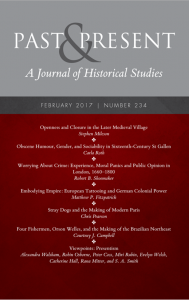
Past & Present is widely acknowledged to be the liveliest and most stimulating historical journal in the English-speaking world. The journal’s contents reflect the Society’s belief that history should be accessible and interesting to a wide range of readers, and its articles are intended to appeal to non-specialists as well as to experts. Since its inception in 1952, the mark of a P&P article was that it should be a properly researched study which showed an awareness of the wider implications of that research. Its remit is worldwide, and across all time periods.
There are four issues a year, each containing around seven major articles with occasional debates and review essays. Our authors come from around the globe, with about half of our articles written by non-UK authors. Subscription to the journal also includes the annual Supplement, which consists of a collection of essays (often the proceedings of Past & Present conferences and other symposia) reflective of the broad themes and ethos of the journal itself.
Archive
You can browse the current issue and the archive online (subscription required for full access to articles), as well as advance access articles that are published ahead of the print edition.
-
October 2025
Vol. 272, Number 1
Page 279.
Air Travel, Statelessness, and the Rights Claims of Ugandan Asians, c.1973* -
August 2025
Vol. 272, Number 1
Page 159.
Fossil Energy and The Ecology of Everyday Life in The Low Countries During The Long Eighteenth Century* -
August 2025
Vol. 272, Number 1
Page 87.
The making and unmaking of religious toleration in Spanish Manila, 1571–1755* -
August 2025
Vol. 272, Number 1
Page 242.
Housing and the Peripheralization of Race Politics in Britain, 1948–1977* -
July 2025
Vol. 272, Number 1
Page 197.
The purposeful workhouse of England’s Old Poor Law* -
June 2025
Vol. 272, Number 1
Page 126.
Making sugar out of opium: A narco-plantation regime in early modern Southeast Asia* -
April 2025
Vol. 272, Number 1
Page 52.
Reckoning and Economic Life in Late Medieval England* -
March 2025
Vol. 272, Number 1
Page 3.
Slavery, Prosperity, and Inequality in Roman Pompeii*
SUPPLEMENTS
The Past and Present Supplement series was launched in 2006 to provide a forum in which to publish the proceedings of Past and Present conferences and other symposia, and collections of essays reflective of the broad themes and ethos of the journal itself. One volume will appear every year,
which will be sent out free to subscribers, but which can also be purchased by non-subscribers as a book. This will also be available online and will be, like the journal, fully searchable.
We welcome detailed proposals for possible future Supplements. Please send proposals to the editorial office.

Medicine, Race, and Slavery in the Transatlantic World, 1600–1850 (2026 Supplement)
Edited by Hannah Murphy
The histories of medicine, transatlantic slavery, and race cannot, and should not, be viewed separately. Between 1440 and 1888 more than twelve million African people were forcibly trafficked across the Atlantic Ocean, enslaved in plantations, cities, and homes across the Americas, the Caribbean, and Europe. As emerging discourses on anatomy, physiology, and disease claimed new authority over explanations for human difference, the same period gave rise to medicalized concepts of ‘race’.
Bringing these developments into a single analytical frame, this Supplement offers a wide-ranging set of case studies spanning Italy, Spain, the Canary Islands, the British and French Caribbeans, Britain, North America, Ethiopia, and the kingdoms and territories of the west coast of Africa. Ranging from the seventeenth to the mid-nineteenth centuries, the contributions draw on diverse archival materials, including inquisitorial trials, port inspections, medical case histories and treatises on disease, missionary correspondence, travel narratives, legal records, newspaper accounts, and first-person testimonies. Foregrounding a broad cast of historical actors – physicians and surgeons, colonial practitioners, metropolitan intellectuals, enslaved women and indigenous healers – the volume traces professional practices, experiences of disease, and the lives of patients, from Canarian nobles to enslaved galley workers. In addressing medical practices within structures of slavery, genealogies of race-medicine, and how the politics of health and healing were themselves racialized, the articles here collectively demonstrate that a critical approach to the role of medicine offers a fresh narrative perspective to the histories of slavery, and a new understanding of the problems of race.

Ordering the Ocean, Ordering the World (2024 Supplement)
Edited by Renaud Morieux and Jeppe Mulich
This Supplement is premised on the notion that oceans were governed and not lawless spaces. Although this idea is now widely shared, the scholarship still tends to focus, on the one hand, on governance and regulatory frameworks, and on the other, on forms of resistance. The concept of `ordering’ enables historians to bypass this dichotomy. The structural changes that took place between the seventeenth and the nineteenth centuries, with respect to state formation, empires, global trade and migrations, were inherently the product of inter-imperial and interpolitical dynamics, processes that happened at sea and not just on land. A focus on the water margins and the polyglot peoples inhabiting them shows how much these changes were shaped from below and from the peripheries. The contributors give centre stage to the plurality of actors, both within and outside the state, who contributed to the process of oceanic ordering. To understand how authority and power were projected across ocean spaces, the articles analyse patterns of political rivalry and collaboration, dissent and negotiation, violence and treatymaking. They track sojourners, privateers, fugitives and officials as they formulated individual or collective visions of order in seas rife with contestation. They chart oceanic ordering from the treacherous reefs of the Mediterranean to the verdant islands of the Caribbean, from quilombos in coastal Brazil to penal settlements in the Indian Ocean, and from makeshift prize courts in seaside colonial taverns to the bustling docks of London.
2025 was a “fallow” year for the Past & Present Supplement series
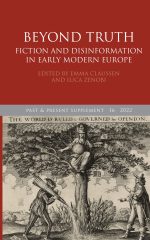
Beyond Truth: Fiction and Disinformation in Early Modern Europe
(2022 Supplement)
Edited by Emma Claussen and Luca Zenobi
Fake news and fabrications have always both intrigued and alarmed. Over and above this ubiquity, at particular historical junctures, awareness — and wariness — of fakery have reached such prominence in public consciousness as to turn it into a cultural phenomenon in its own right. This was the case in the early modern period when, similarly to today, a combination of new technologies and new audiences (with the rise of novels and newspapers and the exponential expansion of the reading public) brought about various crises of communication as well as opportunities for some of the people who lived through them. The telling of tall tales loomed large, both in terms of sheer quantity and in the level of concern raised about them, sparking new ways of thinking about truth and the literary and critical skills required to identify it.
Drawing on a series of papers first presented at a conference in 2018, this Supplement examines fiction, disinformation and the intersections between the two in early modern Europe. The volume brings together literary and historical approaches to these topics, going beyond the novel and the newspaper to look for intersections across a variety of genres: from short stories and legal arguments to biographies and medical reports. Its authors conduct close readings of falsehoods and fictional writings, considering choices of both style and content in light of issues such as creativity, veracity and authenticity. In addition, they highlight how such falsehoods and fictions reveal the agency of readers and writers in reimagining the world around them, by reinforcing existing balances and belief systems or bringing forth new ones. In this sense, the volume is fundamentally a contribution of method, one which showcases a range of interdisciplinary investigations; but it is also a contribution to our understanding of the ideas and exchanges that shaped people’s views and experience of early modern life.
2023 was a “fallow” year for the Past & Present Supplement series
BOOK SERIES
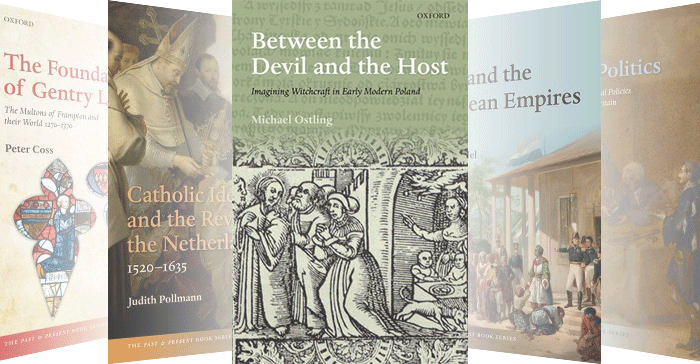
The Society has a long history of publishing books and collections of essays reflective of the broad themes and ethos of the journal itself. Encompassing a range of scholarly and original works primarily concerned with social, economic and cultural changes, their causes and consequences, these volumes endeavour to communicate the results of innovative historical and allied research in readable and lively form to a wide audience. The Past and Present Publications series was established in 1976 and comprises more
than 70 books by both established and early career scholars. Transcending chronological and geographical boundaries, the purpose of the series is to publish high-quality, cutting-edge work that has an appeal outside the specialist area of the author. The series was originally published with Cambridge University Press.
In 2009, the monograph series was re-launched with Oxford University Press as the Past and Present Book Series. Collections
of essays are now primarily published via the Supplement series.
We welcome proposals for possible publication in the series. Please send proposals to the editorial office.
P&P READERS
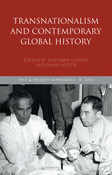
Matthew Hilton writes: In May 2013 Rana Mitter and I published the Past & Present Supplement, Transnationalism and Contemporary Global History. We were aware of a growing interest in the subject and wished to bring together some of the most exciting new research being undertaken around the world. Through a series of essays ranging from wartime China to decolonising Africa we wanted to explore the global spread of ideas, institutions and peoples, especially those that travelled along unexpected paths: hence articles on Indian influences on Kenya or on black Americans in China. Our period was confined to the middle decades of the twentieth century, though we were aware of much other work being conducted on modern history where scholars were exploring the notion of transnationalism.
Certainly, if the download statistics are anything to go by, there is clearly a growing demand for these types of histories. To mark the two years since the supplement was published, we have decided to make the entire volume freely available for a further three months. In addition, we have also made available in this virtual issue a number of other pieces on modern history that have been published in Past & Present over the last few years that might, in other circumstances, have found their way into such a supplement. As with the supplement itself, these will be available free of charge for a period of three months. This virtual issue marks the latest in a series of initiatives in which Past & Present will make parts of its extensive ‘back catalogue’ freely available through the exploration of various historical themes and subjects.
SUBMISSIONS
Journal
We welcome new submissions for the journal in all areas. More information for authors, and detailed submission guidelines, can be found here. The online submission website is here and queries can be directed to the editorial office.
Viewpoint articles: with great success Past & Present recently re-introduced Viewpoint articles to the journal and we particularly invite submissions of Viewpoints. These should seek to provoke or advance debate, to open up new questions, to define the state or direction of a particular field, to shape trends in historiography at a more general level — always in a way that is comprehensible to non-specialists. They might be relatively specific/substantive with respective to area and period or more theoretical. Viewpoint articles would generally have a less formal character than journal articles. The scholarly apparatus of research articles need not be applied so rigorously: polemic could have a place, there might be less need for careful nuance or qualification, or for comprehensiveness of coverage, footnoting could be light, and style could be more individual. These pieces could be flexible in form. Two people (or more) might wish to collaborate on an exchange of views. (We think the difference between such exchanges and our Debates would be that they would not focus on one article). We are flexible in relation to length, but our preference is for Viewpoint pieces which are shorter than articles so that they stand apart.
Please note that we are now practising double-blind reviewing. Submitted texts should therefore be rendered anonymous (you may, if you wish, also submit a separate title page giving author details and acknowledgements).
We hope to reach decisions on most submissions well within four months (and certainly no longer than six), and we will contact you if the refereeing process takes longer than this. We also offer advance access publication, which allows for swift online publication in advance of the print issue.
Open Access Policy
We know that many authors will want to make their work freely available online and we would like to support this. Authors may deposit the ‘accepted manuscript’ version* of their articles in institutional and centrally organized repositories, with an embargo period of 24 months from publication. UK authors should note that articles published in Past & Present are therefore eligible for the post-2014 REF. Further details about self-archiving can be found here. We also offer authors the option of paying an APC (article processing charge) to publish their work freely online immediately on publication.
However, we wish to emphasise that no author is obliged to pay any charge in order to publish in P&P. All our decisions about publication will be taken regardless of whether an author chooses to pay an APC or not. The quality of the work is the only criterion for publication.
* The ‘accepted manuscript’ version of an article is the final draft author manuscript, including modifications based on referees’ suggestions but before it has undergone copy-editing and proof correction.
Supplements
We welcome detailed proposals for possible future Supplements. Please contact the editorial office in the first instance.
Book Series
We also welcome proposals for possible publication in the book series. Please contact the editorial office in the first instance.