

by the Past & Present editorial team
Edited by Dr. Hannah Murphy (King’s College London) the 18th Suppmentary issue of Past & Present “Medicine, Race, and Slavery in the Transatlantic World, 1600–1850” comprising 12 articles has now been published.
The suppment’s abstract explains the volume illustrates that:
“The histories of medicine, transatlantic slavery, and race cannot, and should not, be viewed separately. Between 1440 and 1888 more than twelve million African people were forcibly trafficked across the Atlantic Ocean, enslaved in plantations, cities, and homes across the Americas, the Caribbean, and Europe. As emerging discourses on anatomy, physiology, and disease claimed new authority over explanations for human difference, the same period gave rise to medicalized concepts of ‘race’.
Bringing these developments into a single analytical frame, this Supplement offers a wide-ranging set of case studies spanning Italy, Spain, the Canary Islands, the British and French Caribbeans, Britain, North America, Ethiopia, and the kingdoms and territories of the west coast of Africa. Ranging from the seventeenth to the mid-nineteenth centuries, the contributions draw on diverse archival materials, including inquisitorial trials, port inspections, medical case histories and treatises on disease, missionary correspondence, travel narratives, legal records, newspaper accounts, and first-person testimonies. Foregrounding a broad cast of historical actors – physicians and surgeons, colonial practitioners, metropolitan intellectuals, enslaved women and indigenous healers – the volume traces professional practices, experiences of disease, and the lives of patients, from Canarian nobles to enslaved galley workers. In addressing medical practices within structures of slavery, genealogies of race-medicine, and how the politics of health and healing were themselves racialized, the articles here collectively demonstrate that a critical approach to the role of medicine offers a fresh narrative perspective to the histories of slavery, and a new understanding of the problems of race.”
All of the supplement is currently free to read and a couple of articles are open access.
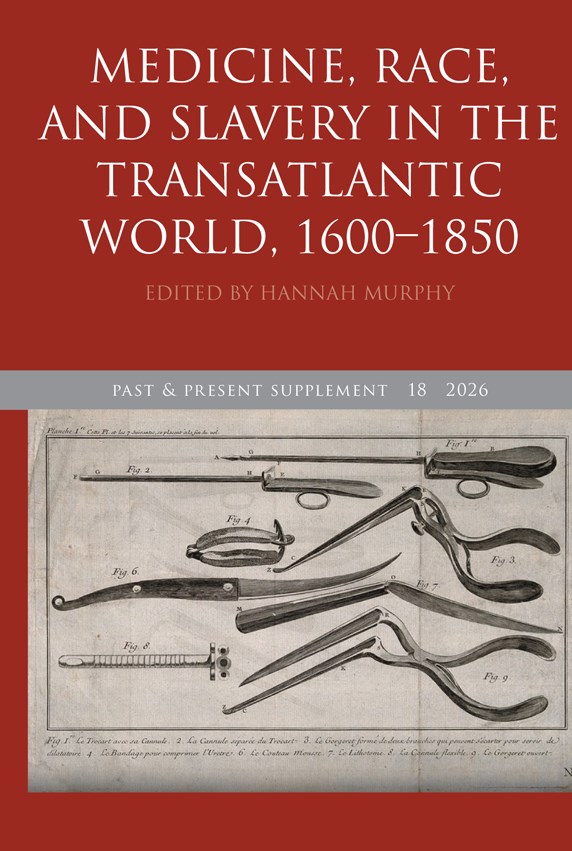
Cover of “Medicine, Race, and Slavery in the Transatlantic World, 1600–1850”, Past & Present Supplement No. 18 (2026)